Effects and mixing
Audio effects explained: drive, compressor, reverb, EQ, pan, sidechain and delay
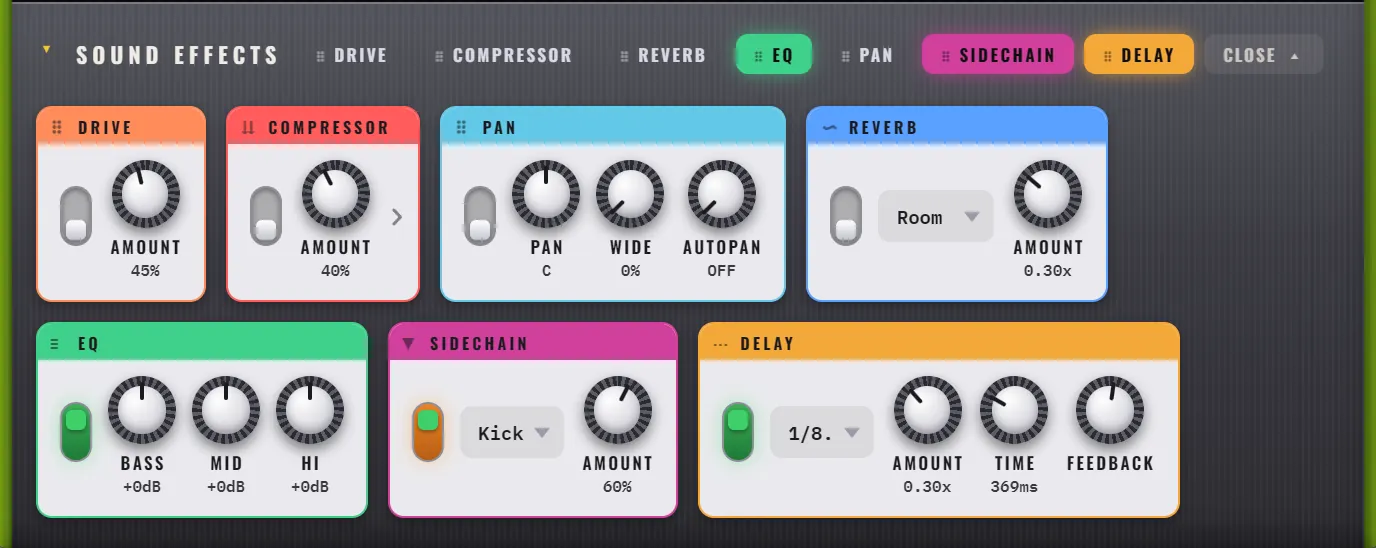
Seven effects shape almost every electronic track. Drive adds grit, a compressor evens out loud and quiet moments, reverb adds space, EQ boosts or cuts bass, mids and highs, pan places a sound left or right, sidechain makes a sound duck under the kick, and delay adds echoes. Every machine in EASY RAVE has all 7 built in, free in your browser.
Where are the effects in EASY RAVE?
At the bottom of every machine there is a SOUND EFFECTS bar. Click it (or its OPEN button) and the rack unfolds with one section per effect, each with its own knobs. The names of the effects that are switched on light up in the bar, so you can see at a glance what is shaping each machine.
Each machine has its own rack. That means you can put reverb on the chords and not on the kick, which is most of what mixing is about.
What does drive do?
Drive (or saturation, or distortion) pushes a sound until its peaks round off and new harmonics appear. A little makes a sound warmer and thicker. A lot turns it into fuzz.
- In EASY RAVE: DRIVE, one AMOUNT knob. Warm at the bottom, heavy fuzz at the top. The volume stays where it was, so you hear the colour change, not a level jump.
- Use it on: basslines that need to cut through, drums that feel too clean, a lead that should snarl.
What does a compressor do?
A compressor turns the loud parts of a sound down, so the gap between loud and quiet gets smaller. The result sounds tighter, punchier and more even.
- In EASY RAVE: COMPRESSOR, with an AMOUNT knob that goes from a gentle 2:1 to a hard 20:1. The small button next to it shows THRESHOLD (where squashing starts) and ATTACK (how fast it reacts). The volume stays where it was.
- Use it on: a drum kit to glue the hits together, a bass that jumps around in level.
What does reverb do?
Reverb simulates the reflections of a room, so a sound seems to happen in a space instead of right against your ear. Short reverb sounds like a room, long reverb like a hall or a cathedral.
- In EASY RAVE: REVERB with 2 types. Room is a natural space. Gated is the huge 80s snare sound that cuts off dead (see gated reverb). AMOUNT goes past 1.0x for a fully drenched sound.
- Use it on: chords, claps, leads. Keep the kick and bass mostly dry, or the low end turns to mud.
What does EQ do?
EQ (equalisation) turns frequency ranges up or down. Cutting the bass of a sound makes room for the real bass. Raising the highs makes a sound brighter.
- In EASY RAVE: EQ with BASS, MID and HI knobs and an ON switch. With ON off, the EQ is bypassed but your settings are kept, so you can compare before and after.
- Use it on: everything, mostly to cut. Turn BASS down on chords and leads so they stop fighting the bass line.
What does pan do?
Pan places a sound between the left and right speakers. Spreading sounds out makes a mix wider and clearer, because parts stop sitting on top of each other.
- In EASY RAVE: PAN has 3 knobs. PAN sets the position. WIDE spreads the machine across both ears. AUTOPAN drifts it slowly across the stereo field, one cycle every 2 bars, around wherever PAN placed it. There is also a PAN knob on each machine's header.
- Use it on: hats, percussion, chords and leads. Keep the kick and the bass in the centre.
What does sidechain do?
Sidechain makes one sound duck in volume every time another plays. In dance music, the bass and chords duck under the kick, which gives the classic pumping, breathing groove and keeps the low end clean.
- In EASY RAVE: SIDECHAIN with 2 modes. Kick follows the kick drum, so the machine ducks under whatever kick is playing. 4/4 pumps steadily on every beat, even with no kick. AMOUNT sets how deep it ducks.
- Use it on: bass, chords, pads. Full explanation in what is sidechain compression.
What does delay do?
Delay repeats a sound as echoes. When the echoes are timed to the tempo, they add rhythm and space without blurring the mix the way reverb can.
- In EASY RAVE: DELAY, synced to the tempo at 1/4, 1/8. (dotted eighth), 1/8, 1/8T (triplet) or 1/16, or FREE to set the TIME knob by hand. AMOUNT sets how loud the echoes are, FEEDBACK how many times they repeat.
- Use it on: chord stabs, leads, a single snare hit. The dotted eighth (1/8.) is the classic dub and techno echo.
In what order should you add effects?
Start with nothing. Add an effect only when you can name what is wrong: "the bass disappears on my laptop" (drive), "the chords and bass are muddy together" (EQ, sidechain), "the clap sounds dry and small" (reverb). One move at a time, and compare by switching it off.
Beyond these 7, the LIVE FX bar at the top adds effects over the whole mix: DROP, NO KICK, ONLY KICK, CRUSH, LO PASS, HI PASS, STUTTER, LOOP, and the PHASER, ECHO and HEAVY knobs. They are for performing, not for setting and forgetting. See live effects. When the effects are set, how to mix a beat covers balancing the levels.
Frequently asked questions
What is the difference between reverb and delay?
Reverb is a wash of thousands of reflections that blend into a sense of space. Delay is a few distinct echoes you can hear one by one. Reverb makes a sound feel far away, delay makes it repeat in rhythm.
What does a compressor do in music?
A compressor reduces the level of the loud parts of a sound, so loud and quiet moments end up closer together. It makes drums punchier, basslines steadier and a whole mix sound more glued and consistent.
What effects should a beginner learn first?
EQ and reverb first: EQ to give every sound its own space, reverb to place sounds in a room. Then sidechain for dance music and delay for rhythmic echoes. Drive and compression come next, to add weight and control.