Effects and mixing
How to mix a beat: levels, panning, EQ and the MIX view
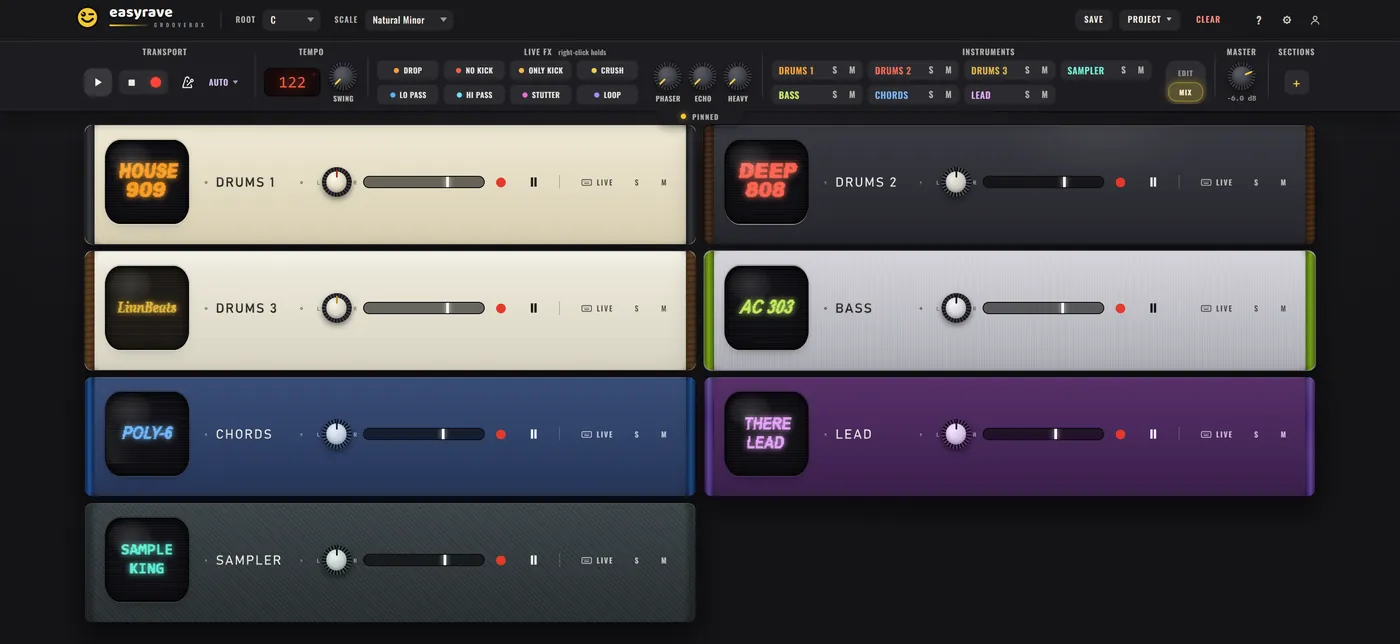
To mix a beat, set the kick's level first, balance the bass against it, then bring in the other parts one at a time. Pan hats and percussion away from the centre, cut the low end from everything except kick and bass, and add effects last. In EASY RAVE, the MIX view (press Tab) folds every machine to its channel strip so you can balance the whole track on one screen.
What does mixing a beat mean?
Mixing is setting how loud each part is, where it sits between the speakers and how much space it takes in the frequency range. A good mix lets you hear every part clearly. A bad one sounds muddy or harsh even if every part is great on its own.
You do not need a studio to learn it. You need a reference point (the kick), a few rules, and the patience to change one thing at a time.
What are the EDIT and MIX views in EASY RAVE?
EASY RAVE has 2 views of the rack, switched with the EDIT / MIX key in the top bar or with Tab:
- EDIT shows every machine the way you left it: sequencers, sound controls, effects. This is where you write.
- MIX folds every machine to its channel strip: its screen, its name, PAN, LEVEL, record, pause, LIVE, S (solo) and M (mute). All 7 fit on one screen, which is where you balance.
The machines keep playing in both views. Only the layout changes.
How do you mix a beat step by step?
- Start with the kick. Solo the drum machine with its S button and set its LEVEL so the kick is strong but not crushing. Everything else is balanced against it.
- Add the bass. Unmute the BASS and bring its LEVEL up until kick and bass feel equally important. If they blur into one thump, raise SIDECHAIN AMOUNT on the bass or cut its very low end with EQ.
- Bring in the rest, one at a time. Chords, then lead, then sampler. Raise each until you can hear it clearly, then back off a little. Most parts end up quieter than you expect.
- Pan. Spread hats, percussion, chords and leads a little left or right with PAN. Keep the kick and the bass in the centre.
- Cut, do not boost. In each machine's EQ, turn BASS down on everything except the kick and the bass. That one move cleans up most muddy mixes.
- Add effects last. Reverb and delay on chords and leads, a gated reverb on the snare, drive where something needs to cut through.
- Check quiet and loud. Listen at low volume: if the kick and bass disappear, they are too low; if one part jumps out, it is too loud. Then check on headphones and on speakers.
How do the levels work?
- LEVEL faders work like a mixing desk: unity gain sits at about three quarters of the travel, the top adds up to 6 dB, and the bottom fades out quickly. Past unity, a machine starts pushing into the master compressor.
- Per-sound volume. Each drum sound and each sampler slot has its own small volume knob, plus M and S, so you can balance inside a kit.
- MASTER in the top bar is the last level before your speakers, and it is the level your recordings get.
EASY RAVE has a compressor and a limiter at the end of the master, so turning everything up squashes the mix instead of distorting it. If the track starts to sound flat and breathless, the cure is to pull the LEVEL faders down, not up.
What do mute and solo do?
M (mute, blue) silences a part. S (solo, amber) plays only the soloed parts. They exist on every machine, on every drum sound and on every sampler slot, and the INSTRUMENTS group in the top bar repeats them for each machine, so you can mute a whole machine from anywhere.
Solo is for finding problems ("is that buzz in the bass or the lead?"). Make balance decisions with everything playing, because a part that sounds perfect alone can still be too loud in the mix.
What are the most common beginner mixing mistakes?
- Everything too loud. Turn things down until the mix has room again.
- Too much reverb. If the mix sounds far away and blurry, halve every reverb AMOUNT.
- Bass and kick fighting. Use sidechain and EQ so they take turns.
- Mixing on one device only. Laptop speakers hide bass and exaggerate mids. Check on headphones too.
Audio effects explained covers the 7 effects in each machine's rack.
Frequently asked questions
What should I mix first in a beat?
Start with the kick drum, because it is the loudest and most important element in most beats. Set its level, balance the bass against it, then add the other parts one at a time, adjusting each against what is already there.
How loud should the kick be compared to the bass?
In most electronic music, the kick and the bass should feel about equally strong, taking turns rather than playing at the same moment. Sidechain on the bass helps: the bass ducks briefly whenever the kick hits.
What is the MIX view in EASY RAVE?
The MIX view folds all seven machines down to their channel strips, with LEVEL, PAN, mute and solo, so you can balance the whole track on one screen. Press Tab or the EDIT / MIX key in the top bar to switch.