Drums and rhythm
Drum patterns for beginners: 8 beats to program on a step sequencer
Most electronic and hip-hop beats grow out of 8 basic drum patterns. Each one is shown below on a 16-step grid, where every column is a 16th note and every group of 4 is one beat, with the tempo it usually runs at. You can program all of them for free in EASY RAVE's drum machines, in your browser.
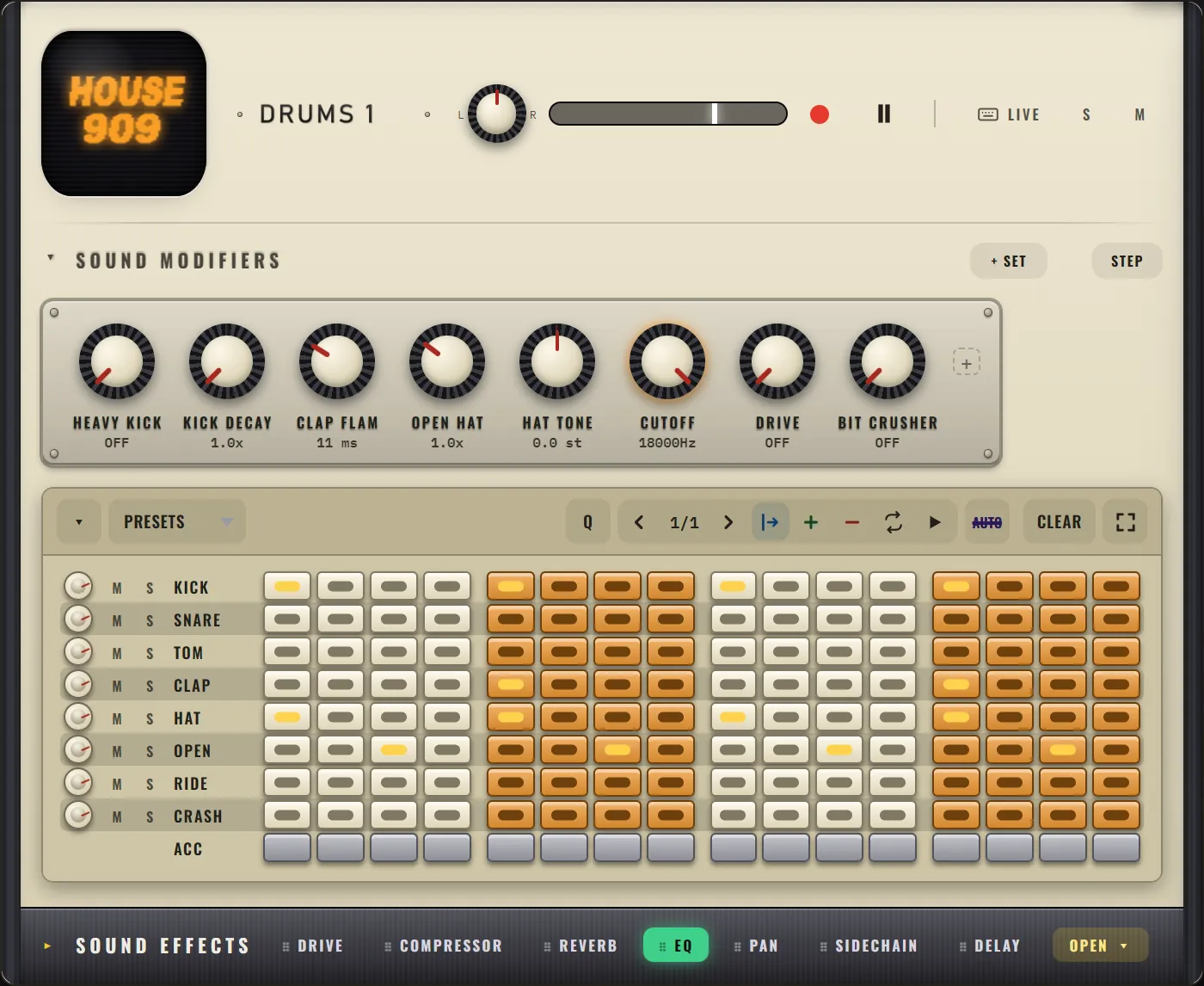
How do you read a drum grid?
Each row is one drum sound and each of the 16 columns is a 16th note. Columns 1, 5, 9 and 13 are the 4 beats you would count out loud ("one, two, three, four"). A lit cell means "play here".
A capital X is an accent: the hit plays louder. In EASY RAVE you accent a step by right-clicking it, or by lighting the ACC row under the grid.
To try any pattern, open the free online drum machine in EASY RAVE, press CLEAR on a drum machine's sequencer bar and click the steps in. What is a step sequencer explains the grid in more detail.
1. The basic backbeat
Backbeat (any tempo, 90 to 120 BPM)
| 1 | 2 | 3 | 4 | 5 | 6 | 7 | 8 | 9 | 10 | 11 | 12 | 13 | 14 | 15 | 16 | |
|---|---|---|---|---|---|---|---|---|---|---|---|---|---|---|---|---|
| KICK | ||||||||||||||||
| SNARE | ||||||||||||||||
| HAT |
Kick on beats 1 and 3, snare on 2 and 4, hats on every 8th note. This is the beat under most pop and rock music, and the one to learn first. Everything else on this page is a variation of it.
2. Four on the floor
Four on the floor (120 to 130 BPM)
| 1 | 2 | 3 | 4 | 5 | 6 | 7 | 8 | 9 | 10 | 11 | 12 | 13 | 14 | 15 | 16 | |
|---|---|---|---|---|---|---|---|---|---|---|---|---|---|---|---|---|
| KICK | ||||||||||||||||
| CLAP | ||||||||||||||||
| HAT |
The kick moves to every beat. That steady thump is the base of disco, house and techno. Swap the snare for a clap and it already sounds like dance music.
3. House
House (120 to 128 BPM)
| 1 | 2 | 3 | 4 | 5 | 6 | 7 | 8 | 9 | 10 | 11 | 12 | 13 | 14 | 15 | 16 | |
|---|---|---|---|---|---|---|---|---|---|---|---|---|---|---|---|---|
| KICK | ||||||||||||||||
| CLAP | ||||||||||||||||
| HAT | ||||||||||||||||
| OPEN |
The open hat on the offbeat, between the kicks, is what makes it house. The closed hats leave a gap wherever the open hat plays. Add a little SWING and the 16ths start to roll. Full recipe in how to make house music.
4. Techno
Techno (125 to 135 BPM)
| 1 | 2 | 3 | 4 | 5 | 6 | 7 | 8 | 9 | 10 | 11 | 12 | 13 | 14 | 15 | 16 | |
|---|---|---|---|---|---|---|---|---|---|---|---|---|---|---|---|---|
| KICK | ||||||||||||||||
| HAT | ||||||||||||||||
| OPEN | ||||||||||||||||
| RIDE |
Same kick, more drive on top. The accented offbeat 16ths push the groove forward, and the ride adds a metallic wash. Turn HEAVY KICK up on HOUSE 909 for a harder kick. More in how to make techno.
5. Boom bap
Boom bap (85 to 95 BPM)
| 1 | 2 | 3 | 4 | 5 | 6 | 7 | 8 | 9 | 10 | 11 | 12 | 13 | 14 | 15 | 16 | |
|---|---|---|---|---|---|---|---|---|---|---|---|---|---|---|---|---|
| KICK | ||||||||||||||||
| SNARE | ||||||||||||||||
| HAT |
The hip-hop beat of the late 80s and 90s. The kick dances around the snare instead of sitting on the beat, and the snare cracks hard on 2 and 4. Use DEEP 808 or LinnBeats, and turn SWING up for a lazier feel. The same idea at a slower tempo is the start of a lo-fi beat.
6. Breakbeat
Breakbeat (100 to 140 BPM)
| 1 | 2 | 3 | 4 | 5 | 6 | 7 | 8 | 9 | 10 | 11 | 12 | 13 | 14 | 15 | 16 | |
|---|---|---|---|---|---|---|---|---|---|---|---|---|---|---|---|---|
| KICK | ||||||||||||||||
| SNARE | ||||||||||||||||
| HAT |
Breakbeats come from the drum breaks of funk records. The two accented snares carry the backbeat, and the quiet "ghost" snares on steps 8 and 16 make it bounce. Leave the ghost notes unaccented so they stay in the background.
7. Drum and bass
Drum and bass two-step (160 to 180 BPM)
| 1 | 2 | 3 | 4 | 5 | 6 | 7 | 8 | 9 | 10 | 11 | 12 | 13 | 14 | 15 | 16 | |
|---|---|---|---|---|---|---|---|---|---|---|---|---|---|---|---|---|
| KICK | ||||||||||||||||
| SNARE | ||||||||||||||||
| HAT |
Very fast, but very simple: one kick on beat 1, one just after beat 3, snares on 2 and 4. At 170 BPM the gap between kick and snare feels like a rolling bounce. EASY RAVE's tempo goes up to 180 BPM, so drag the TEMPO display all the way up.
8. Electro
Electro (110 to 130 BPM)
| 1 | 2 | 3 | 4 | 5 | 6 | 7 | 8 | 9 | 10 | 11 | 12 | 13 | 14 | 15 | 16 | |
|---|---|---|---|---|---|---|---|---|---|---|---|---|---|---|---|---|
| KICK | ||||||||||||||||
| CLAP | ||||||||||||||||
| HAT | ||||||||||||||||
| COWBELL |
A syncopated kick that never sits still, a hard clap, and an 808-style cowbell. Program it on DEEP 808, which has the cowbell, and tune it with COWBELL TUNE until it fits the key of the bass.
How do you make a pattern sound less robotic?
- Accents. Accent 1 or 2 hats per beat. The pattern stays the same, but it starts to breathe.
- Swing. The SWING knob delays every other 16th note. A little gives groove, a lot gives shuffle.
- A second bar. Press + to copy the bar and change it slightly: drop a kick, add a snare at the end. Real drummers rarely play 2 identical bars in a row.
- Fills. Every 4 or 8 bars, put a few LOW TOM or SNARE hits at the end of the bar.
- Mute and unmute live. Every sound has its own M (mute) and S (solo) button. Taking the kick out for a bar is the cheapest build there is.
Where are the factory beats?
Every EASY RAVE drum machine has a PRESETS menu with 6 ready beats: Techno, House, Hip-hop, Breakbeat, Drum & bass and Electro. Load one, compare it with your own version above, and keep what you like with + SET, which saves your pattern as one of your own sets.
Frequently asked questions
What is the easiest drum pattern to learn?
The basic backbeat: kick on beats 1 and 3, snare on beats 2 and 4, hi-hats on every 8th note. On a 16-step grid that is kick on steps 1 and 9, snare on 5 and 13, and hats on every odd step.
What is a four on the floor beat?
Four on the floor means a kick drum on every beat of the bar: steps 1, 5, 9 and 13 on a 16-step grid. It is the foundation of disco, house and techno, usually between 120 and 130 BPM.
How many steps is a bar of drums?
On most drum machines one bar has 16 steps, one for each 16th note, so 4 steps make one beat. In EASY RAVE every drum machine uses 16 steps per bar and can hold up to 64 bars.