Drums and rhythm
What is a step sequencer? How to program drums step by step
A step sequencer is a grid that plays a loop of steps in time, usually 16 per bar, where each step you switch on plays a sound. You build a beat by clicking steps instead of performing it live. Every machine in EASY RAVE, the free browser groovebox, has its own step sequencer with accents, swing, up to 64 bars and a quantize function.
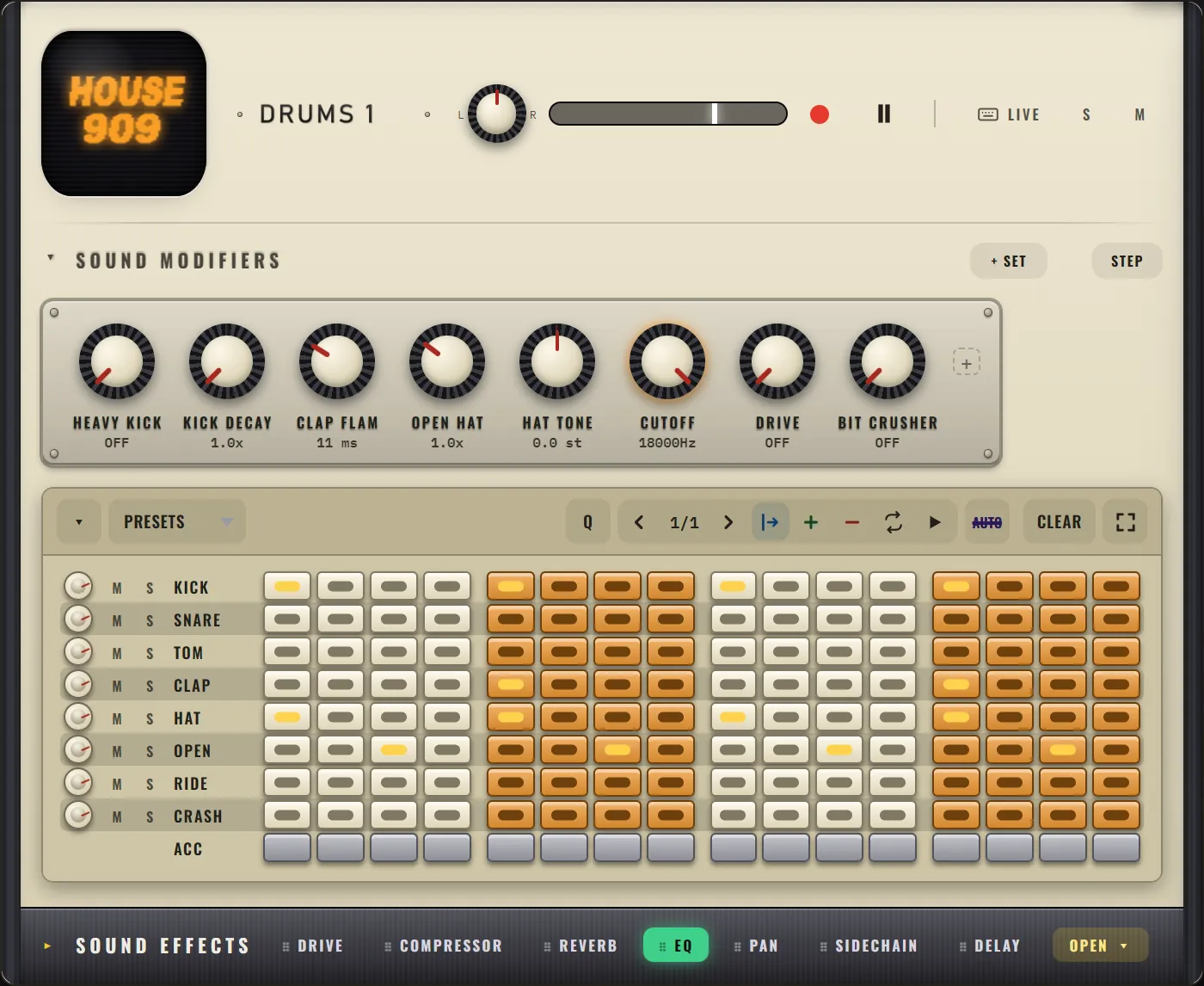
How does a step sequencer work?
A step sequencer splits a bar of music into equal slots, called steps, and plays them one after another in a loop. Each step is either on or off. When the playhead reaches a step that is on, the sound plays.
On a drum machine each sound gets its own row of steps. On a synth, each step also stores a note. Because the steps are locked to the tempo, everything you program is perfectly in time, even if you have never played an instrument.
Why 16 steps?
Music is usually counted in bars of 4 beats. Split each beat into 4 and you get 16 steps per bar, one for each 16th note:
The 16 steps of one bar
| 1 | 2 | 3 | 4 | 5 | 6 | 7 | 8 | 9 | 10 | 11 | 12 | 13 | 14 | 15 | 16 | |
|---|---|---|---|---|---|---|---|---|---|---|---|---|---|---|---|---|
| BEATS | ||||||||||||||||
| 8THS | ||||||||||||||||
| 16THS |
Steps 1, 5, 9 and 13 are the beats you count out loud. The steps in between are where groove lives: a kick or a hat that lands just off the beat is what makes a pattern feel like it moves.
How do you program a beat on a step sequencer?
In EASY RAVE every machine has the same sequencer bar. On a drum machine:
- Press CLEAR to empty the bar you are viewing.
- Click a step on the KICK row to light it. Click again to switch it off. Drag across steps to light several at once.
- Press play (or Space). The playhead runs across the grid and the bar loops.
- Fill in the other rows: snare or clap, hats, then extras.
Drum patterns for beginners has 8 beats to copy while you learn.
What are accents?
An accent makes one step play louder and punchier than the rest. Without accents, every hit has the same strength, which sounds mechanical. With a few accents on the hats or the kick, the same pattern sounds played.
On the EASY RAVE drum machines you accent a step by right-clicking it, or by lighting the step in the ACC row under the grid. On the AC 303 bass, accents have their own ACCENT lane under the piano roll, next to a SLIDE lane for gliding notes.
What does swing do?
Swing delays every second 16th note a little, so pairs of notes go "long-short, long-short" instead of "even-even". It is the difference between a march and a groove.
The SWING knob sits next to the tempo in EASY RAVE's top bar and affects every machine at once. A rough guide by ear:
- A little (the first quarter of the knob): house and techno hats start to roll.
- More: hip-hop and lo-fi drums lean back.
- A lot: a full shuffle, like a jazz ride cymbal.
Swing works best on patterns with 16th notes. On a beat with only quarter notes, you will not hear it at all.
How do bars, pages and loops work?
One screen of 16 steps is one bar. In EASY RAVE each machine can hold up to 64 bars, and the sequencer bar has everything to move around them:
| Control | What it does |
|---|---|
| ‹ › and the counter (1/1) | Move between bars and show which one you are viewing |
| + | Add a bar at the end, as a copy of the one you are viewing |
| − | Remove the bar you are viewing |
| Follow | The view turns to the bar that is playing |
| Loop bar | Loop just the bar you are viewing, on this machine only |
| ▶ | Play from this bar |
| CLEAR | Clear the bar you are viewing |
| Fullscreen | See and edit every bar of the machine at once |
Copying a bar with + and changing a few steps is the fastest way to write a 2 or 4 bar phrase that does not repeat itself exactly.
Can you record into a step sequencer instead of clicking?
Yes, in two ways:
- Live recording. Press LIVE on a machine and the number keys play its sounds. Press ● REC and you get a one bar count-in; everything you play after it is written onto the grid, snapped to the steps. REC starts a fresh take, so the old pattern on that machine is cleared first (save it with + SET if you want to keep it).
- STEP recording. With the song stopped, press STEP. Every key you hit lands on the next step and the cursor moves on, so you can enter a pattern one hit at a time, at your own pace.
If a live take came out sloppy, Q (quantize) snaps every note already in the machine onto a grid you choose: 1/16, 1/8, 1/4 or 1/1. Playing with your keyboard or MIDI covers live input in detail.
Frequently asked questions
What is the difference between a step sequencer and a piano roll?
A step sequencer switches fixed steps on and off, usually 16 per bar, which is ideal for drums. A piano roll shows notes as bars on a grid of pitch and time, so it suits melodies. EASY RAVE uses step grids for drums and the sampler, and piano rolls for the bass and lead.
How many steps should a drum pattern have?
Most drum patterns use 16 steps per bar, one per 16th note. A single bar is enough to start; adding a second bar with small changes makes the pattern sound less repetitive.
Is there a free online step sequencer?
Yes. EASY RAVE is a free groovebox in your browser where every machine has its own step sequencer, starting with its online drum machine: 3 drum machines, a bass synth, a chord synth, a lead and a sampler, all in sync.